Invoicing
Auto-entrepreneur invoices: the 9 mandatory details, and the 4 mistakes that get them refused
A refused invoice is a payment that slips by a month. Here is what an accounts department checks before paying, and how to never miss a detail.
By the SoloGestion team · · 7 min read
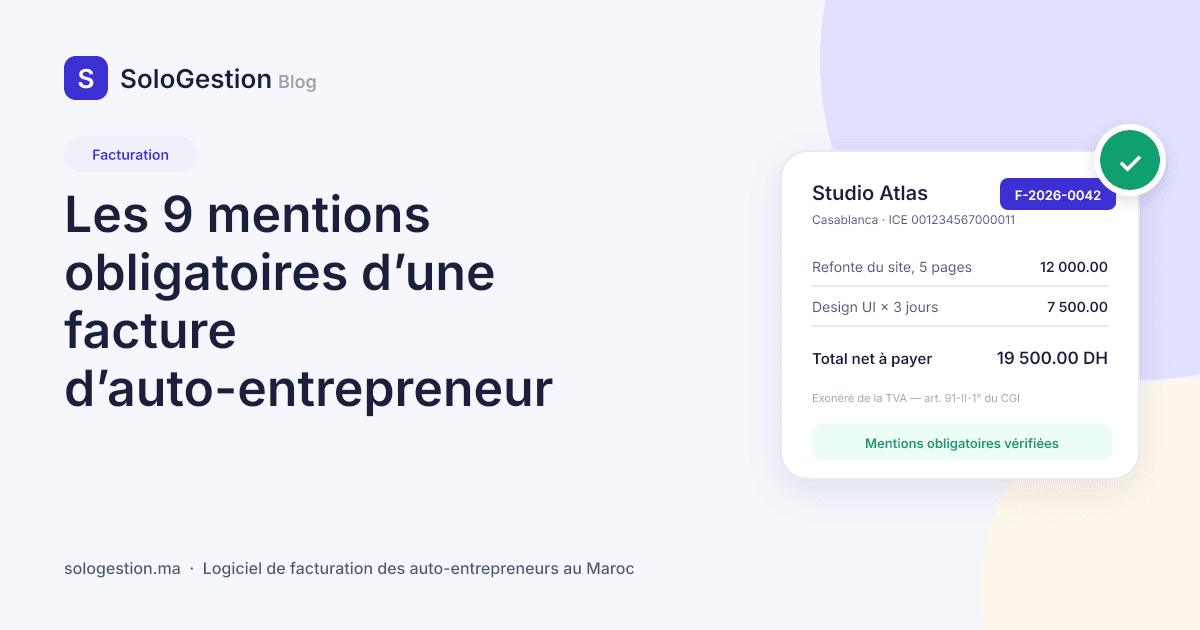
A client who refuses an invoice is almost never acting in bad faith. Their accounts department has a checklist, and one missing detail is enough to hold the payment until next month. The good news: the list is short, it is the same for every activity under the regime, and once your template is set you never think about it again. This article goes through the list detail by detail, then the four mistakes behind nine refusals out of ten. For the broader picture, the auto-entrepreneur invoice guide is the reference.
The 9 details an auto-entrepreneur invoice must carry
- 1Your first and last name, or your trade name if it appears on your register entry. A trade name alone is not enough if the register does not know it.
- 2Your business address, the one declared at registration. If you work from home, that is your home address, and that is normal.
- 3Your ICE (common business identifier), 15 digits. It is the detail companies check first, because it lets them deduct the expense.
- 4Your tax identifier (IF), issued by the tax administration. It is on your registration certificate.
- 5Your national auto-entrepreneur register number. The three identifiers are explained in the ICE, tax ID and AE number guide.
- 6The invoice number, unique and sequential: F-2026-0001, F-2026-0002, with no gap or duplicate, in date order.
- 7The issue date, and the due date if you grant payment terms. Without a due date there is no solid basis for a reminder.
- 8The client’s identity: name or company name, address, and its ICE if it is a company. For an individual, name and address are enough.
- 9The detail of services or products, quantities, unit prices and total in dirhams, followed by the “VAT exempt, art. 91-II-1° of the tax code” mention specific to the auto-entrepreneur status, and the amount in words.
Add your payment details (bank account number, and any other means you accept). It is not a legal requirement, but it is what turns a compliant invoice into a quickly paid one: the accountant does not have to write to ask where to send the transfer.
The official register model, and why to follow it
The national auto-entrepreneur register hands every member an invoice model. It is not strictly compulsory, but it has one decisive advantage: every accounts department in the country recognises it. It carries the programme emblem, a number, the client with its ICE, a grey-headed table, the net total payable, the amount in words, the exemption mention as a footnote and a full identity block in the footer (national ID, ICE, tax ID, business tax, phone, email). Reproducing it faithfully, with your logo and signature, removes any debate about form. That is what SoloGestion’s “official” template does.
The 4 mistakes that get an invoice refused
1. The client’s ICE is missing or wrong
When you invoice a company, its ICE must appear on the invoice: that is what lets it book the expense. A missing ICE, or one with an extra digit, is the first cause of refusal. Ask for it at the quote stage, check it has 15 digits, and store it on the client record so it is reused on every document. A client whose ICE changes (merger, change of legal form) should warn you; when in doubt, ask for a copy of its certificate.
2. The numbering has a gap
An invoice F-2026-0007 following F-2026-0005 raises a question for any inspector: where is 0006? Numbers must follow without interruption, in date order. If you cancel an invoice, it stays in the sequence and you issue a credit note; you never delete it. The most frequent cause of gaps is the draft: an invoice prepared, numbered, then abandoned. The healthy rule is to assign the number only at issue, never before.
3. The VAT mention is missing, or says the opposite
An auto-entrepreneur is not subject to VAT and does not charge it. But the invoice must say so, otherwise the client looks for the VAT, does not find it and sends the document back. The phrase “VAT exempt, art. 91-II-1° of the tax code” is enough, under the total or as a note. The opposite mistake is worse: a “VAT 20%” line added because the template came from company software. That invoice is false, and a client who pays it while deducting non-existent VAT faces a reassessment. So they will refuse it.
4. The description does not say what was sold
“Service” alone does not pass. Write what you did, for whom and over which period: “Website redesign, 5 pages, delivered 12 October”. A clear description also avoids the argument at reminder time, and it serves as evidence if the payment has to be claimed. For products, one line per item with the variant (size, colour) and the quantity.
Three last-second checks
- The total in figures and the amount in words say the same thing. Accountants compare the two.
- The due date is later than the issue date, and consistent with the accepted quote. The quote guide explains how the quote sets those terms.
- The client name on the invoice is exactly the one on its register: “Atlas Digital SARL”, not “Atlas”.
How to never think about it again
All of this is settled once, in your template. Your identifiers are entered at sign-up and reused automatically, numbering is handled by the software, the exemption mention is printed on every document and the client’s ICE is requested when you create a company. Only the description remains, and that is the part that deserves your attention. If you still invoice in Word or Excel, the article Invoicing in Excel or with software does the honest maths on when the spreadsheet starts to cost.
One last point, often forgotten: an invoice is not a receipt. It records a claim; the payment is recorded separately, with its date and means. That payment register is the basis of your quarterly tax, and an auto-entrepreneur keeps it in fifteen minutes a week.
Frequently asked questions
- Is the ICE compulsory on an auto-entrepreneur invoice?
- Yes, yours always, and the client’s as soon as it is a company. Without the client’s ICE, it cannot book the expense, and that is the first cause of refusal.
- Should I write “VAT not applicable” or “VAT exempt”?
- The register’s official model uses “Exonéré de la TVA — art. 91-II-1° du CGI” (VAT exempt). That is the wording to use; “VAT not applicable” comes from French templates and is not the Moroccan administration’s.
- Can I invoice in English?
- Yes, if the client prefers it. The details remain those of the Moroccan regime, the amount stays in dirhams and the exemption mention stays that of article 91. SoloGestion prints the same document in both languages.
- Is an invoice without the auto-entrepreneur number valid?
- It is incomplete. The national register number is one of the expected details; an attentive client will send it back. It is on your certificate and explained in the identifiers guide.