Getting paid
Chasing an unpaid invoice: 5 polite emails that get you paid (templates to copy)
Chasing is not begging. With the right tone and the right schedule, most invoices get paid before the second reminder. Here are the five messages, ready to copy.
By the SoloGestion team · · updated 19 October 2026 · 8 min read
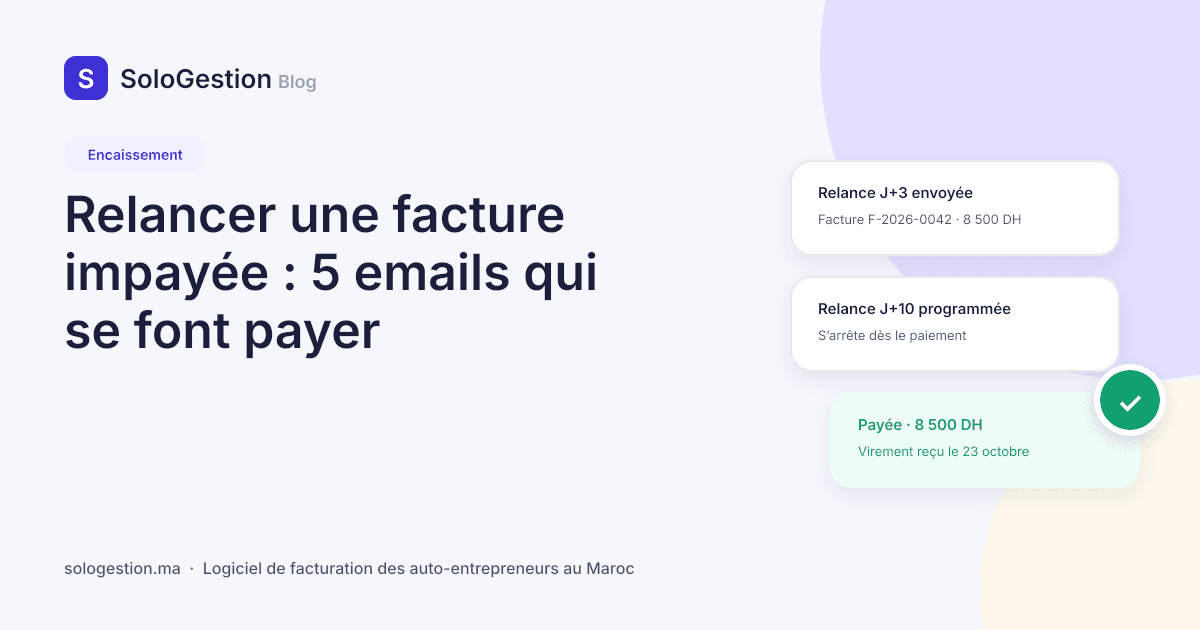
A late payment is rarely a refusal. It is an invoice at the bottom of an inbox, a manager on leave, a transfer “planned for next week”. The reminder puts your invoice back on top of the pile without damaging the relationship. Tone matters as much as timing, and timing matters as much as wording: a reminder sent on the right day gets read; the same one, sent three weeks too late, gets negotiated. The five templates below cover the whole sequence, from the courteous note to the formal notice. The reminders guide explains how to automate them.
The schedule that works
- 3 days before the due date: friendly note, mostly to check the invoice reached the right person.
- 3 days after the due date: first reminder, neutral and short. Most delays stop here.
- Day 10: second reminder, which offers a solution (instalments, a call) and looks for the cause of the block.
- Day 21: firm reminder, which announces what comes next without threatening.
- Day 35: formal notice, by email and by registered letter with acknowledgement of receipt.
This schedule assumes a due date written on the invoice and accepted in the quote. Without it, you are chasing “a late payment” the client does not consider late. It is one of the details that changes what follows the most.
Template 1: before the due date (day −3)
Subject: Invoice F-2026-0042, due 20 October
Hello Karim, a quick note: invoice F-2026-0042 for 8,500 MAD is due on 20 October. You will find it attached. If it is already being processed, please ignore this message. Have a good day, Yasmine
Why it works: the message accuses nobody. It gives the accountant what they need to schedule the transfer, and it surfaces a lost invoice before it is late.
Template 2: first reminder (day +3)
Subject: Invoice F-2026-0042, due 20 October
Hello Karim, unless I am mistaken, invoice F-2026-0042 (8,500 MAD), due on 20 October, has not been paid yet. Could you confirm the transfer date? I am available if any document is missing. Thank you, Yasmine
Why it works: “unless I am mistaken” leaves the client an honourable way out, and the question is precise: a date, not an explanation.
Template 3: second reminder (day +10)
Subject: Invoice F-2026-0042, 10 days overdue
Hello Karim, invoice F-2026-0042 remains unpaid to date, ten days after its due date. Is anything blocking on my side (missing detail, different contact)? If full payment is difficult, I can offer two instalments. Could we talk this week? Kind regards, Yasmine
Why it works: you look for the cause. A missing ICE, a purchase order not issued, an absent manager: half the delays at day 10 have an administrative reason that this message brings out.
Template 4: firm reminder (day +21)
Subject: Invoice F-2026-0042, last reminder before formal notice
Hello Karim, despite my two reminders, invoice F-2026-0042 for 8,500 MAD, due on 20 October, is still unpaid. Without payment or a reply within 7 days, I will have to start recovery proceedings. I would rather avoid that step and remain open to a conversation. Yasmine
Why it works: the tone changes, not the politeness. You recall the history (two reminders), you set a deadline, and you leave a door open. Send this message with the person who approved the quote in copy.
Template 5: formal notice (day +35)
By email and by registered letter with acknowledgement of receipt. Subject: Formal notice to pay, invoice F-2026-0042
Dear Sir or Madam, I hereby give you formal notice to pay invoice F-2026-0042 for 8,500 MAD, issued on 20 September and due on 20 October, within eight days of receipt of this letter. Failing that, I will refer the matter to the competent court. Copy of the invoice and the accepted quote attached.
The formal notice is the document that opens the way to legal action; it must be dated, signed, and accompanied by the evidence (accepted quote, invoice, previous reminders). In Morocco, the order for payment before the commercial court is a relatively fast procedure for a certain, written claim: that is why a quote accepted in writing matters so much.
Three rules that change everything
- 1Always attach the invoice, and state the number, amount and due date in the first sentence. The reader must not look for anything.
- 2One reminder, one goal: knowing when the transfer leaves. No blame, no apology, no novel.
- 3Never chase an invoice already paid. Reconcile your payments before each send; a reminder for an invoice settled the day before costs more in trust than a month of delay.
Preventing beats chasing
The least-chased auto-entrepreneurs are those with a deposit on big jobs, a short due date with individuals, and a bank account number printed on every invoice. Add a payment link when possible, and a description the accountant understands without opening the quote. The rest is the schedule above, applied without exception.
Frequently asked questions
- Can I charge late-payment penalties?
- Only if the quote or the accepted terms provide for them. Without a written clause, claiming penalties strains the relationship without a solid basis. The formal notice, however, needs no clause.
- Should I chase by phone or by email?
- By email first, because it leaves a trace and attaches the invoice. The call comes at the second reminder, when you look for the cause of the block.
- How many reminders before giving up?
- Five steps up to the formal notice, over about 35 days. Beyond that, an order for payment before the commercial court is possible for a certain, written claim.
- Does an automatic reminder look bad?
- Not if it is polite, short and sent at the right time. Accounts departments are used to them; what looks bad is a reminder for an invoice already paid.